Reading Comprehension · Level 8 · المستوى 8
Water, Mountains and the Future of Jebel Akhdar
الماء والجبال ومستقبل الجبل الأخضر
Read the text
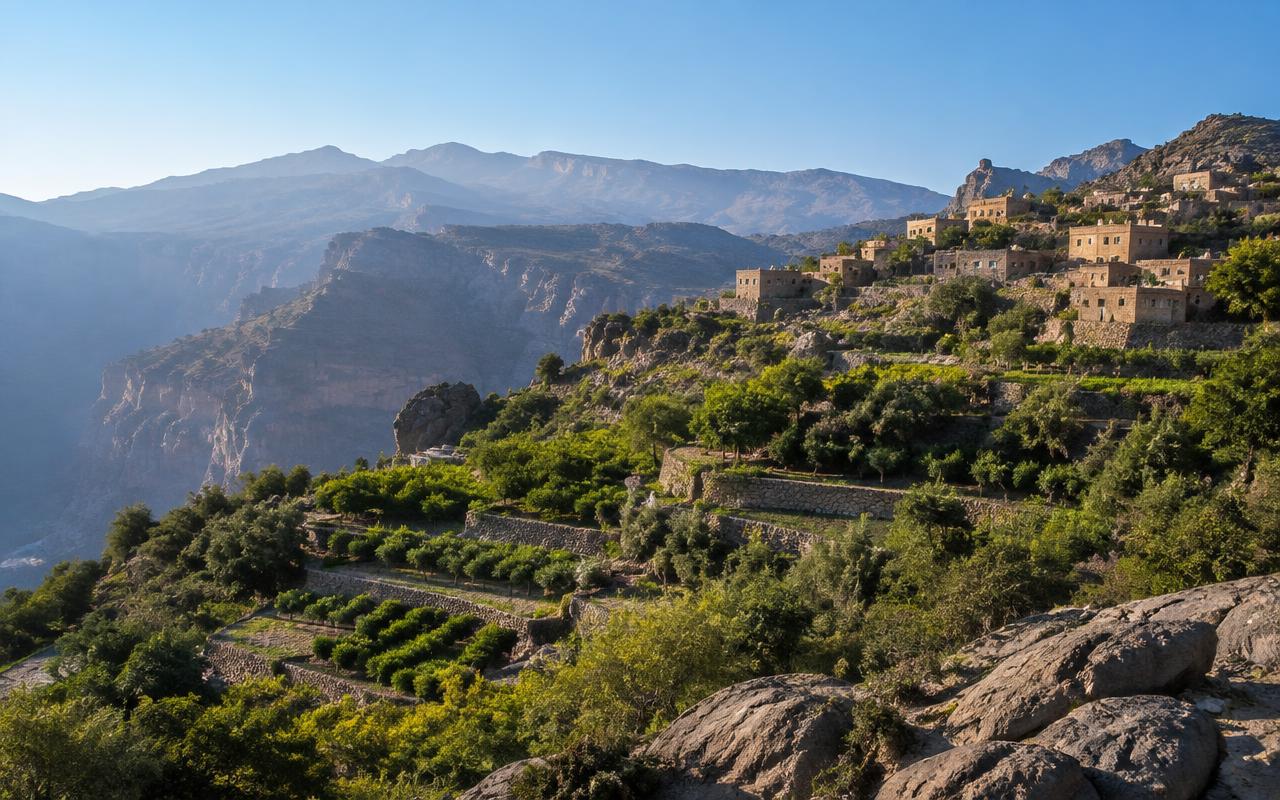
اقرأ النصAt around two thousand metres above sea level, the terraced villages of Jebel Akhdar present one of the most striking agricultural landscapes in the Arabian Peninsula. Pomegranates, walnuts, apricots and the famous Damask roses grow on narrow stone platforms that follow the contours of the mountainside. The terraces are not merely picturesque; they represent an elaborate solution to a double problem: how to create flat, fertile ground on steep slopes, and how to distribute scarce water among many households.
For centuries, this solution depended on a delicate balance. Rainfall recharged underground aquifers, aflaj carried water to the terraces, and a carefully negotiated schedule governed its use. Labour was communal: when a wall collapsed after heavy rain, neighbours repaired it together. The system's resilience lay less in any single element than in the relationships between them — ecological, technical and social.
In recent decades, several of these relationships have weakened simultaneously. Improved roads, while bringing clear benefits, have made it easier for young people to seek employment elsewhere, leaving fewer hands to maintain walls and channels. Tourism has created income, yet hotels and guesthouses also draw on the same limited groundwater. Meanwhile, climate data suggest that rainfall is becoming less predictable, with longer dry periods interrupted by intense storms that erode rather than replenish.
It would be simplistic, however, to present this as a story of inevitable decline. Some farmers have adopted drip irrigation, reducing water use without abandoning traditional crops. Rose-water production, once largely domestic, has become a valued product that links agriculture to tourism in a way that rewards the upkeep of terraces. Researchers and local communities have also begun documenting traditional water-management knowledge before it is lost.
The central question, then, is not whether Jebel Akhdar will change — it already has — but whether change can be managed so that the underlying balance survives. That will require decisions that treat water not simply as a commodity, but as the thread that holds the landscape, the economy and the community together. The terraces were built by people who could not afford to waste a single season's rain. Their descendants may find that the same discipline is now a matter of choice rather than necessity, and therefore harder to sustain.
Answer the questions
أجب عن الأسئلة1. What is the main argument of the passage?
2. According to paragraph 2, where did the system's strength come from?
3. Which pressure is NOT mentioned?
4. 'a double problem' (paragraph 1) refers to…
5. 'storms that erode rather than replenish' means the storms…
6. 'simplistic' (paragraph 4) means…
Inference · استنتاج
7. What is the relationship between paragraph 3 and paragraph 4?
Inference · استنتاج
8. What does the writer imply in the final sentence?
Inference · استنتاج
9. What is the writer's attitude?
Select the evidence · اختر الدليل
10. Which sentence shows that one development can have both benefits and costs?
Select the evidence · اختر الدليل
11. Which example shows traditional agriculture adapting successfully?
Summary · التلخيص
12. Choose the best summary of the whole passage.
13. Why does the writer describe water as 'the thread'?
Short answer · إجابة قصيرة
14. Name one sign of positive adaptation mentioned in the text.
Practice freely — nothing is saved.تدرّب بحرية، لا يتم حفظ أي إجابة أو نتيجة.
Next: Level 8 · Attention in the Age of the Scroll →