Reading Comprehension · Level 7 · المستوى 7
Crafts in a Machine Age
الحِرف في عصر الآلة
Read the text
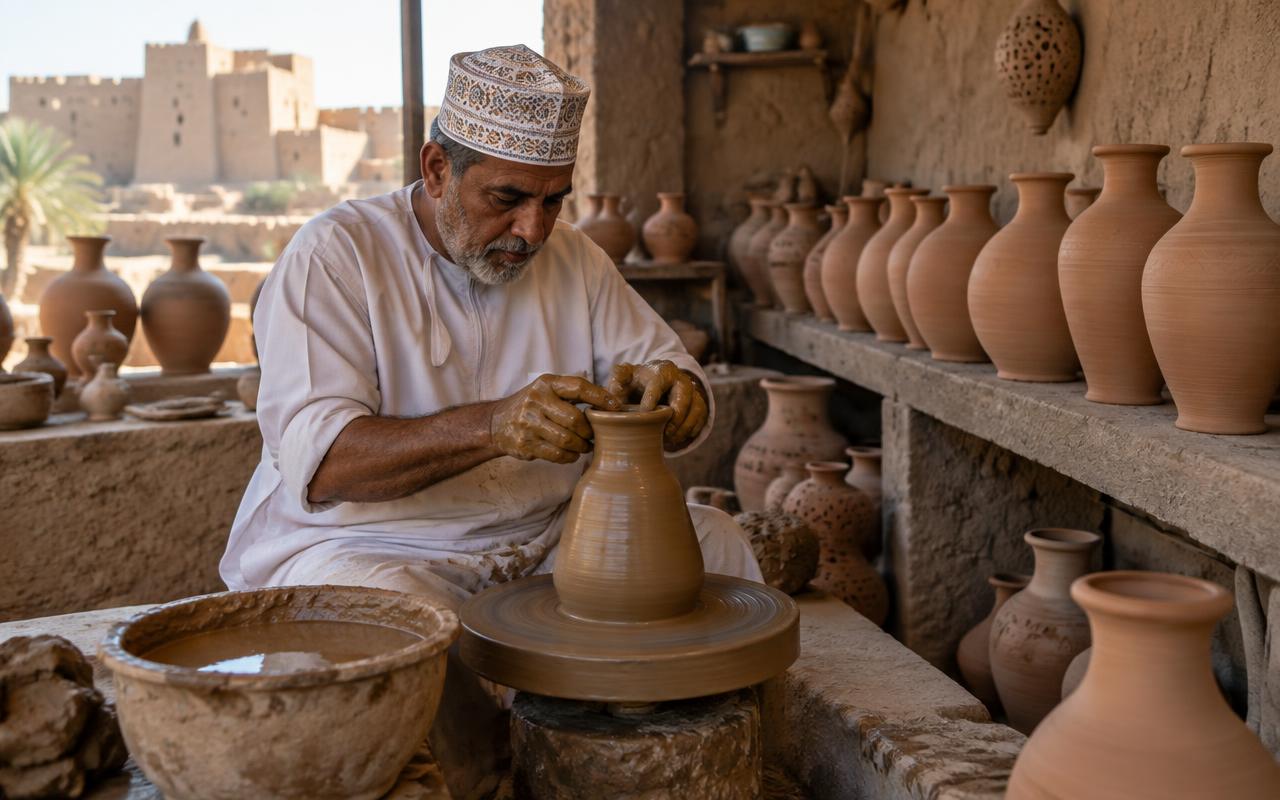
اقرأ النصIn a workshop on the edge of Bahla, a potter kicks a wheel with his foot while his hands draw a jar out of wet clay. The technique has hardly changed in centuries. The clay comes from the nearby wadi; the kiln is fed with palm wood. A single large jar can take days to shape, dry and fire.
Across the country, similar skills survive: silversmiths who hammer patterns into khanjar sheaths, weavers who work goat hair into rugs, and in Sur, shipwrights who once built dhows without drawings, relying on memory and experience. These crafts were never merely decorative. Pots stored water, rugs furnished homes, and dhows carried Omani trade across the ocean.
The difficulty today is economic. A factory-made plastic container costs a fraction of a clay jar and never breaks. Young people, understandably, often prefer steady jobs with regular salaries to long apprenticeships with uncertain income. In several villages, the number of active craftspeople has fallen sharply within a single generation.
Government programmes, craft centres and festivals have helped, and some artisans have found new markets by selling online or designing modern products — clay lamps, silver jewellery for everyday wear — that use traditional techniques. Critics warn that this risks turning living skills into tourist products. But a craft that cannot earn a living will not survive, however much it is admired.
Perhaps the most hopeful sign is a quieter one: a growing number of young designers who see the old crafts not as nostalgia, but as knowledge. The potter's understanding of clay, heat and air is, after all, a kind of science.
Answer the questions
أجب عن الأسئلة1. What is the main problem facing traditional crafts?
2. How did Sur's shipwrights once build dhows?
3. What is one way artisans have found new markets?
4. 'never merely decorative' means the crafts were…
5. 'understandably' shows the writer thinks young people's choice is…
6. 'living skills' (paragraph 4) are skills that…
Inference · استنتاج
7. Connect paragraphs 3 and 4: why does the writer accept some commercial change?
Inference · استنتاج
8. What does the last sentence suggest?
Select the evidence · اختر الدليل
9. Which sentence gives evidence that crafts are declining?
10. Which is an OPINION, not a fact?
Short answer · إجابة قصيرة
11. Name two traditional crafts mentioned.
12. The writer's attitude towards the crafts' future is…
Practice freely — nothing is saved.تدرّب بحرية، لا يتم حفظ أي إجابة أو نتيجة.
Next: Level 8 · Two Views of a Changing City →