Reading Comprehension · Level 5 · المستوى 5
The Falaj: Sharing Water Fairly
الفلج: تقاسم الماء بعدل
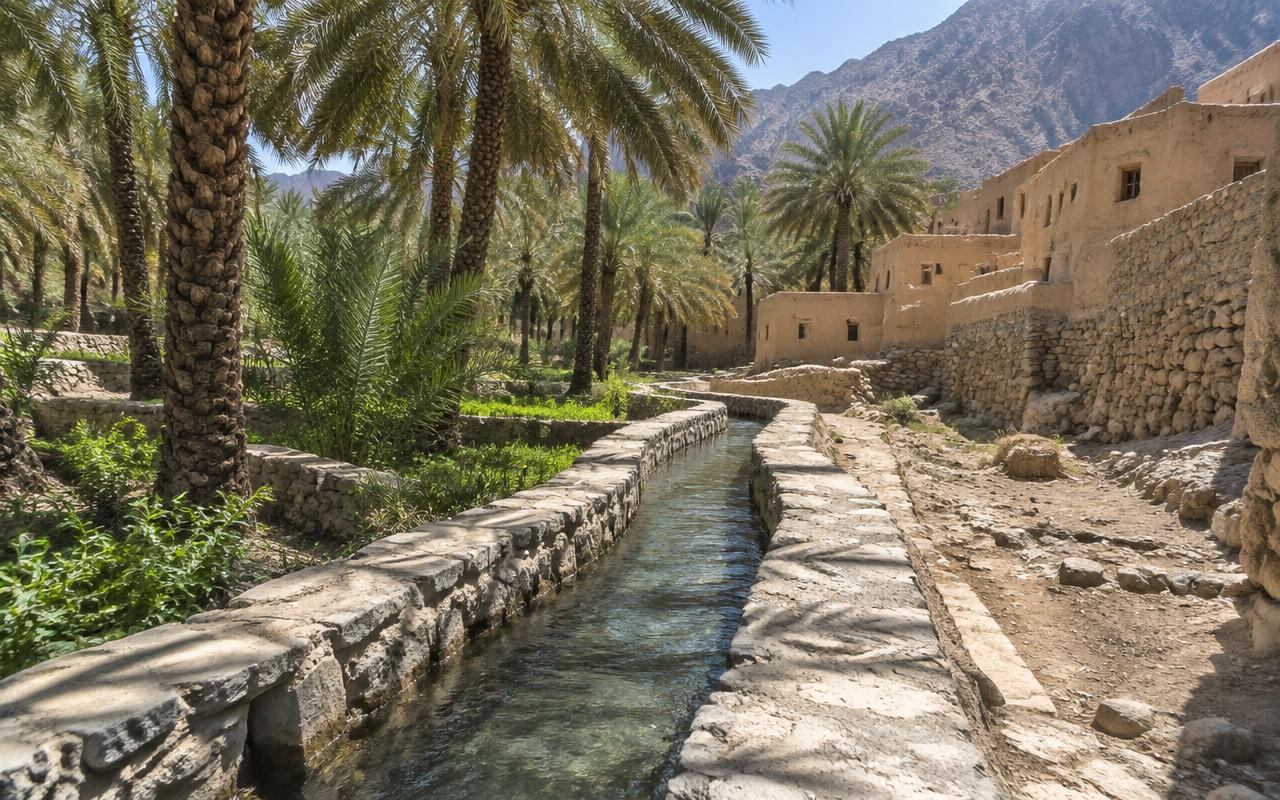
Read the text
اقرأ النصIn a country where rain is rare and rivers are almost nonexistent, water has always been precious. For centuries, Omanis solved this problem with the aflaj (singular: falaj), a network of channels that carry water from underground sources or mountain springs to villages and farms. Five of these systems are now listed as UNESCO World Heritage Sites.
Some aflaj begin with a 'mother well' dug deep into the ground near the mountains. From there, a tunnel slopes gently downhill for many kilometres until the water appears on the surface. Building one required remarkable skill: if the slope was too steep, the water would destroy the tunnel; if it was too flat, the water would stop flowing.
Just as impressive as the engineering is the social system behind it. Water is divided by time, not by quantity. Each farmer owns a number of 'shares', and each share gives the right to use the falaj for a fixed period. In the past, time was measured by the movement of the sun during the day and by the stars at night.
A respected person, often called the wakil, manages the falaj. He records who owns which shares, organises repairs and settles disagreements. The first water, which is the cleanest, is used for drinking; then it passes the mosque and bathing areas, and finally it reaches the fields. This order reflects a clear set of priorities that the whole community accepts.
Today, many villages use pumps and pipes, and some aflaj have dried up as underground water levels have fallen. Yet in places such as Al Hamra and Nizwa, the old channels still run, reminding visitors that sustainability is not a new idea in Oman.
Answer the questions
أجب عن الأسئلة1. What is the passage mainly about?
2. How is falaj water divided?
3. What is the wakil's job?
True / False · صح أم خطأ
4. True or False: The water reaches the fields before it is used for drinking.
5. 'rivers are almost nonexistent' means…
6. 'settles disagreements' (paragraph 4) means…
7. In paragraph 2, 'remarkable' is closest in meaning to…
Inference · استنتاج
8. Why is the wakil described as 'a respected person'?
Inference · استنتاج
9. What does the order of water use suggest about village values?
Select the evidence · اختر الدليل
10. Which sentence proves that building a falaj was difficult?
Select the evidence · اختر الدليل
11. Which phrase shows that some aflaj are in danger?
12. What does the final sentence suggest?
Short answer · إجابة قصيرة
13. In the past, how was time measured at night?
14. Best title?
Practice freely — nothing is saved.تدرّب بحرية، لا يتم حفظ أي إجابة أو نتيجة.
Next: Level 5 · Do We Still Need Libraries? →